Tree Removal Cost 2026: $300–$2,500 by Tree Size + Stump Grinding Prices
Tree removal costs $300–$500 (small trees, under 30 ft) to $1,200–$2,500 (large, 60–80 ft). Stump grinding adds $100–$400. National average: $875. How to get fair quotes and avoid arborist overcharges.
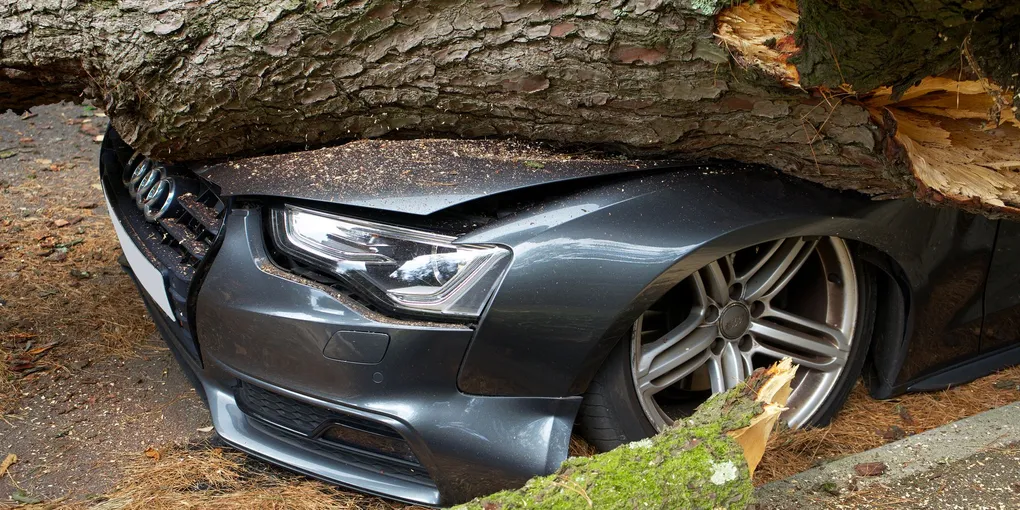
Tree removal costs $300–$500 for small trees (under 30 ft), $600–$1,200 for medium trees (30–60 ft), $1,200–$2,500 for large trees (60–80 ft), and $2,500–$6,000+ for very large trees (80+ ft) in 2026. Stump grinding adds $100–$400. Emergency removal (storm damage, hazardous lean) doubles or triples the cost. The national average for a single medium-sized tree removal is $875, and most homeowners spend $500–$1,500 per tree.
Frequently Asked Questions
Does homeowners insurance cover tree removal?
Yes, in specific cases: if a tree falls on your home, garage, or fence due to wind, lightning, or weight of snow/ice — insurance usually covers removal and repair. If a tree falls in your yard without damaging a covered structure, insurance typically does NOT cover removal. Diseased or dying trees that you knew about before they fell are generally excluded (insurers argue this is a maintenance issue).
How much does it cost to remove a fallen tree?
A fallen tree is usually cheaper to remove than a standing tree because no climbing or rigging is needed — just cutting and hauling. Typical cost: $300–$800 for a small-to-medium fallen tree, $800–$2,000 for a large one. Add $150–$400 if the tree is on a structure (needs careful extraction). Add $200–$500 for extensive cleanup of branches and debris.
Should I remove the stump too?
If you want to plant anything in that spot, yes — stumps rot slowly and prevent new planting for 10+ years. If you're OK with the stump remaining, leaving it saves $100–$400. Stump grinding is cheaper than full extraction. Ground stumps leave a soil mix 4–8 inches below grade, which you fill with topsoil and grass seed. Full stump extraction costs $400–$1,200 and is rarely necessary.
How long does tree removal take?
A small tree (under 30 ft): 1–2 hours. A medium tree: 2–4 hours. A large tree with close structures or power lines: 4–8 hours. A very large tree requiring rigging and careful sectioning: 1–2 full days. Cleanup adds 30–60 minutes. Most arborists schedule jobs 1–4 weeks out in normal conditions; emergency work is same-day at 2–3x the price.
How do I avoid tree removal scams?
Verify the company has: ISA certification (International Society of Arboriculture) for at least one arborist on staff, state contractor licensing where required, workers' comp and general liability insurance ($1M+ minimum), and proof of certificate of insurance delivered to you before work begins. Avoid: door-to-door solicitors (classic post-storm scam), cash-only demands, large upfront deposits (over 25%), and any crew without climbing ropes and rigging gear. Get 3 written quotes.
Can I remove a tree myself to save money?
You can legally remove trees on your own property in most jurisdictions, but it is rarely a good idea for trees over 20 feet tall. Falling direction is difficult to control without proper rigging, and a misfall can destroy fencing, structures, or vehicles in seconds. DIY is reasonable for: small ornamental trees under 15 feet, trees clearly away from structures with open drop zones, and you have a chainsaw and understand basic felling technique. For large trees, the contractor cost is legitimate risk management.
What is the best time of year to remove a tree?
Winter (dormant season) is often the best time: the ground is firm (easier cleanup), no leaves mean better sight lines and lower debris volume, arborists are less busy (sometimes lower prices), and there is less stress on neighboring plants from the disruption. Emergency removals happen year-round. Spring and summer have longer backlogs from storm-damage calls. Fall is a good time if trees are diseased — removing before leaf drop eliminates one season of seed/spore spread to neighboring plants.
How much does it cost to remove a large oak tree?
Large oak tree removal (60-80 feet tall) typically costs $1,200-$3,500 in 2026. Very large oaks (80+ feet, mature canopy spread) run $3,000-$7,000+. Oak is a hardwood — it's denser and slower to cut than softwood trees, which adds 15-25% to removal cost compared to a pine or spruce of the same size. Factors that push oak removal toward the high end: proximity to structures or power lines (requires careful rigging), trunk diameter over 36 inches, multiple trunks, soft/rotten wood that is harder to cut safely. Stump grinding adds $150-$500 for a large oak (big root system). Get 3 quotes — oak removal price varies widely by crew experience and equipment.
How much does it cost to cut down a pine tree?
Pine tree removal costs $300-$500 for small pines (under 30 ft), $600-$1,200 for medium pines (30-60 ft), and $1,200-$2,500 for large pines (60-80 ft) in 2026. Pine is a softwood — lighter and easier to cut than hardwoods, which makes pine removal 10-20% cheaper than oak or maple of the same height. Pine-specific considerations: sap makes equipment sticky and can add minor cleanup time; dead pines are extremely dry and brittle (higher risk of unexpected breakage, which may increase rigging requirements and price); long pines near rooftops require careful sectional removal rather than a single fell, adding cost. Stump grinding adds $100-$300 for average pine stumps.
Tree removal costs $300–$500 for small trees (under 30 ft), $600–$1,200 for medium trees (30–60 ft), $1,200–$2,500 for large trees (60–80 ft), and $2,500–$6,000+ for very large trees (80+ ft) in 2026. Stump grinding adds $100–$400.
Tree removal is one of those services where quotes can swing wildly. The same tree might get bids of $500, $1,200, and $2,800 depending on who you call, the season, and whether the company figured they could upsell a storm victim. This guide breaks down what tree removal actually costs in 2026, what drives pricing up or down, and how to avoid the inflated quotes and outright scams that show up after every storm.
Cost at a Glance
| Tree Height | Typical Cost | Notes |
|---|---|---|
| Small (under 30 ft) | $300–$500 | Dogwood, Japanese maple, small pine |
| Medium (30–60 ft) | $600–$1,200 | Standard residential trees |
| Large (60–80 ft) | $1,200–$2,500 | Mature oaks, hickories, maples |
| Very large (80–100 ft) | $2,500–$5,000 | Old-growth hardwoods |
| Massive (100+ ft) | $4,000–$10,000+ | Ancient hardwoods, highly accessible pines |
These are national averages for standing, healthy trees with reasonable access. Add-ons can easily double the base cost.
What Drives the Price
1. Tree Height
The core pricing factor. Taller trees require more climbing time, more complex rigging, and often a bucket truck or crane. Price scales roughly exponentially with height — a 60 ft tree is 2x the cost of a 30 ft tree, not 1.5x.
2. Trunk Diameter
A thick trunk takes longer to section and haul. Doubling trunk diameter typically adds 20–40% to the price. Trees with multiple trunks (clumping species like river birch, or old trees that split) are priced by the largest trunk plus a smaller fee for each additional.
3. Species
Softwoods (cheaper): pine, spruce, fir, cedar, hemlock.
Hardwoods (15–25% more): oak, maple, hickory, ash, walnut, beech.
Problem species:
- Silver maple and willow: brittle wood; requires careful rigging to prevent falling branches.
- Black locust: dense, thorny, slow to section.
- Oak (storm-damaged): often has internal rot; requires extra care.
4. Location and Access
The single biggest driver of cost variation. Trees fall into categories:
- Easy access: front yard, no power lines, no structures nearby, equipment can drive to the base. Base rate.
- Medium access: backyard, fenced yard requiring partial disassembly, some nearby structures. +25–40%.
- Difficult access: close to house or power lines, requires rigging/sectioning instead of felling, hand-carry of debris through a narrow gate. +50–100%.
- Crane required: tight urban lots, trees over structures, or very large trees. Adds $1,500–$5,000 for crane day rate.
5. Stump Grinding
Almost always a separate line item.
- Small stump (under 12” diameter): $75–$150
- Medium stump (12–20”): $150–$250
- Large stump (20–30”): $250–$400
- Very large stump (30”+): $400–$800
Bundling stump grinding with removal on the same visit saves 20–40% vs. calling the crew back later.
6. Debris Disposal
- Log haul-away: $75–$200 extra (some crews chip and keep the wood)
- Chipping of brush: usually included
- Log-sized sections left on site: free (you handle them)
- Full cleanup including raking and blowing: $75–$200 extra
7. Emergency / Storm Work
After a storm, prices spike 50–200%. Arborists book out for days, crews work overtime, and demand exceeds supply. If the tree isn’t an immediate hazard, wait a few weeks for rates to normalize.
What Shouldn’t Be Extra
Some line items are legitimate add-ons. Others are padding that a fair quote wouldn’t include:
Legitimate extras:
- Stump grinding
- Haul-away of logs (unless they’re chipping)
- Crane rental (specifically for difficult jobs)
- Structural protection (plywood over pools, sheds, etc.)
- Permit fees (some jurisdictions)
Red flags that shouldn’t be extra:
- “Drop zone preparation” (just means they’ll cut the tree down)
- “Safety equipment”
- “Fuel surcharge”
- “Disposal fee” on top of haul-away
- “Travel time” if you’re within 20 miles
- “Tree marking” or “assessment”
If a quote has more than 2–3 line items you don’t recognize, ask for clarification. A good company explains everything.
Common Scenarios and Real-World Prices
Standard Medium Oak in the Backyard ($800–$1,500)
A 40–50 ft oak in a fenced backyard with no power lines nearby. Crew dissects the tree from the top down, lowering sections with rigging. Brush chipped on site, logs cut into firewood-length rounds and stacked. Stump grinding adds $150–$250.
Large Pine Near the House ($1,500–$3,000)
A 60–70 ft pine 15 feet from the roof. Requires a bucket truck or experienced climber with rigging. Sections lowered carefully to avoid landscaping. Plywood protection for pool or deck. Stump grinding $200–$350.
Storm-Damaged Tree on Roof ($2,000–$6,000)
A large tree fallen on or through the roof. Requires coordination with the homeowner’s insurance, tarping the damaged area immediately, and careful extraction to avoid further damage. Almost always an emergency rate, 1.5–3x normal pricing. Insurance typically covers this.
Huge Old Oak in a Tight Lot ($3,500–$8,000)
A 80+ ft oak on a narrow urban lot with a fence, neighboring houses, and limited access. Requires crane rental ($1,500–$3,000 additional), full street closure permit (varies), and a 2-day job. Stump grinding for a 40+ inch trunk can add $600–$1,000 alone.
Red Flags to Watch For
-
Door-to-door solicitors after a storm. Legitimate companies don’t knock on doors. Classic storm-chasers from out of state.
-
Cash-only payment. A legitimate company accepts checks and credit cards.
-
Large upfront deposit. 10–25% deposit is normal for big jobs. 50%+ deposit is not.
-
No proof of insurance. Ask for a certificate of insurance (COI) before work begins. Call the insurance company to verify.
-
No ISA certification for large/hazardous work. The International Society of Arboriculture certifies arborists; a non-certified crew shouldn’t be working on trees over 30 ft or near structures.
-
Can’t provide references. Every legitimate company has recent customers willing to vouch.
-
Pressure to decide immediately. “We’re in the neighborhood today only” is a scam tactic.
-
Quote dramatically below competitors. Usually means they’ll add surprise charges, cut corners, or are uninsured and shifting risk to you.
-
No written contract. Get the scope, price, and timeline in writing. Verbal quotes change when the invoice arrives.
Should You Remove the Tree Yourself?
DIY if:
- Tree is small (under 20 ft)
- No structures or power lines within falling distance
- You have a chainsaw and basic experience
- You’re willing to spend a weekend on cleanup
Don’t DIY if:
- Tree is large or near anything valuable
- Power lines nearby (legally requires utility crews or certified arborists)
- You don’t have proper PPE (chainsaw chaps, helmet with face shield, hearing protection)
- Tree is leaning, diseased, or storm-damaged (unpredictable fall direction)
DIY tree removal is one of the highest-injury home projects per the CDC — an average of 400+ chainsaw-related deaths per year in the US. For anything larger than a sapling, hire a professional.
Insurance Claims for Tree Damage
If a tree falls on your home, garage, fence, or car due to wind, lightning, or snow weight:
- Photograph everything immediately. The tree, the damage, and the surrounding area.
- Tarp the damage if exposed to weather. Home insurance often covers this emergency action.
- File a claim promptly. Most policies require notification within 24–72 hours.
- Get quotes from licensed/insured tree companies. Your insurance adjuster will want estimates.
- Don’t pay cash for “quick” removal. Use a company that’ll submit an insurance-compliant invoice.
If a neighbor’s tree falls on your property, coverage gets complicated. Generally:
- Wind/storm caused the fall: Your insurance covers (with deductible), then pursues your neighbor’s insurance.
- Tree was already diseased/dead and the neighbor knew: Neighbor’s insurance covers.
- Neither is negligent: Your insurance covers.
A good arborist can provide written documentation of the tree’s condition, which strengthens insurance claims.
Reducing Future Tree Costs
- Annual inspection by a certified arborist ($50–$150) catches problems early when they’re cheaper to address
- Pruning every 3–5 years ($150–$500 per tree) reduces storm damage risk
- Fertilization for stressed trees extends their lifespan
- Mulching around the base improves root health (but keep mulch 2–3 inches from the trunk)
- Watering during drought especially in the first 3 years after planting
Healthy, well-maintained trees live 50–200+ years. Removal becomes necessary only when a tree is dying, diseased beyond recovery, or in conflict with structures.
When Removal Is Necessary
- Dead or dying (visible bark shedding, no leaves in spring, fungal conks on trunk)
- Structural problems (large cracks in the trunk, bark included in branch crotches)
- Leaning significantly toward a structure (especially if the lean has increased)
- Root damage from construction, flooding, or herbicides
- Species-specific disease (Emerald Ash Borer, Dutch Elm Disease, Oak Wilt)
- Interfering with power lines (utility will remove for free in most service areas)
Regional Tree Removal Cost Variations
| Region | Small Tree (under 30 ft) | Medium Tree (30–60 ft) | Large Tree (60+ ft) |
|---|---|---|---|
| Northeast (NY, MA, NJ) | $450–$1,000 | $900–$2,200 | $1,800–$4,500 |
| Mid-Atlantic (DC, MD, VA) | $400–$900 | $800–$2,000 | $1,600–$4,000 |
| Southeast (FL, GA, TX) | $300–$700 | $600–$1,600 | $1,200–$3,200 |
| Midwest | $325–$750 | $650–$1,700 | $1,300–$3,500 |
| Pacific (CA, WA, OR) | $400–$950 | $800–$2,100 | $1,700–$4,200 |
Prices include felling, limbing, and debris removal. Stump grinding adds $100–$400. Log splitting for firewood: some companies offer this free or at reduced price vs. chipping.
Tree Service Provider Comparison
| Provider Type | Best For | Cost Level | Notes |
|---|---|---|---|
| ISA-Certified Arborist (local) | Best all-around; accountable; proper technique | Moderate | ISA certification is the primary credential; find at treesaregood.org; proper pruning and removal technique |
| Davey Tree Expert Company | Large trees; complex removals; commercial | Moderate–High | National company; consistent quality; ISA-certified crews; good for high-risk trees near structures |
| Bartlett Tree Experts | Premium; complex urban trees; disease diagnosis | High | Research-backed arborist services; best for tree health issues beyond simple removal |
| Asplundh / utility line clearing | Utility-adjacent trees; emergency clearing | Variable (often utility-funded) | Utility companies contract Asplundh; contact your utility for trees near power lines (often free removal) |
| Local unlicensed crew | Never — avoid for trees over 20 ft | Low | ”Guy with a truck and chainsaw” creates serious liability; no insurance, no training |
| DIY (small trees under 20 ft) | Simple small trees away from structures | Materials only ($30–$100 for equipment) | Feasible with proper safety training; never DIY near power lines or structures |
Always verify ISA certification and insurance. A tree that falls on your neighbor’s house during removal by an uninsured crew is your liability — not theirs.
Questions to Ask Your Tree Service
-
Are you ISA-Certified (International Society of Arboriculture), and do you carry liability insurance and workers’ compensation? Can you provide certificates before starting? — ISA certification (Certified Arborist) requires passing an exam, demonstrating field experience, and maintaining continuing education. It’s the primary credential that separates trained arborists from unqualified crews. Ask: “What is your ISA certification number?” and verify at treesaregood.org. More importantly: ask for a certificate of insurance before they start work. A $2,000 tree removal by an uninsured crew that damages your roof or drops a limb on a neighbor’s car is your liability to cover. Getting the COI in hand before work begins is non-negotiable.
-
What is the plan for removing this tree — what direction will it fall, how will you handle sections near the house, and what equipment will you use? — Ask the crew chief to walk you through the removal plan: which direction sections will be dropped, how they’ll handle limbs overhanging the house or fence, and whether they’ll use a crane, bucket truck, or climbing. A crew that can’t articulate a specific plan for a complex removal is working from improvisation, not planning. For trees within 20 feet of a structure, crane-assisted removal (suspending sections rather than dropping them) adds $500–$1,500 but eliminates impact risk.
-
Is cleanup and debris removal included in the quote, and what happens to the wood — chip, haul, or leave? — Tree removal generates large volumes of wood chips, branches, and sections of trunk. Ask: “Is all debris removed from the property, and is that included in the price?” Also ask: “What happens to the log sections?” Some companies will chip everything on-site (leaving chips in a pile — sometimes useful for mulch), haul everything away (cleanest), or leave log sections for you to deal with. If you want firewood, ask whether they’ll buck the trunk into rounds at no charge — many will. Define the scope upfront so there’s no dispute about who’s hauling the brush pile.
-
Is stump grinding included, and to what depth will the stump be ground? — Stump grinding is almost always a separate line item. Ask: “Is stump grinding included, and if so, to what depth?” Standard stump grinding goes 6–12 inches below grade — adequate for planting over the area but not deep enough to run a lawn mower over without noticing the depression. Deep grinding (12–18 inches) adds $50–$100 per stump but is required if you plan to replant in the same location. Also ask: “What happens to the grindings?” — stump grindings can be left as fill or removed, and they often get mixed with soil in a way that prevents planting for 1–2 years.
-
If this tree is near a power line, has the utility company been contacted, and is utility clearing a separate scope? — Trees touching or growing into power lines are the utility company’s responsibility in most service territories. Before paying a private arborist for this work, ask: “Have you confirmed this is the homeowner’s responsibility, or should the utility company be handling it?” Most utilities will remove trees that directly threaten their lines at no cost to the homeowner (Asplundh or their contract crew handles it). If a private arborist is needed due to proximity to lines without direct contact, ask whether they have utility line clearance training and what the procedure is if a line is accidentally contacted during work.
DIY supplies (if you tackle it yourself)
- Chainsaw (14-inch electric)
- Tree cutting wedges (plastic)
- Log splitter (manual)
- Stump killer (chemical)
Related Reading
- Tree Trimming Cost
- Stump Grinding Cost — the follow-up step after tree removal; $100–$400 per stump
- Fence installation cost
- Deck building cost per square foot
- How to fertilize your lawn
- Spring home maintenance checklist
- Annual home maintenance schedule
- How to seal a driveway
The Bottom Line
Tree removal in 2026 costs $300–$2,500 for most residential jobs, with large or hazardous trees running $2,500–$6,000+. Stump grinding adds $100–$400. The pricing depends heavily on height, species, access, and whether a crane is needed. Always get three quotes, verify insurance and ISA certification, watch for the classic post-storm scam tactics, and call 811 before stump grinding. Most homeowners who do their homework pay 20–40% less than the highest quote they get, often without any sacrifice in quality.
- Measure the tree accurately
Height: estimate by comparing to your home (most residential roofs are 25–35 ft). Measure trunk diameter at 4.5 feet above ground. Note obstructions: power lines, fences, septic tanks, sheds, neighboring homes, and anything that limits how the tree can be lowered.
- Identify the species (affects price)
Softwoods (pine, spruce, fir): easier to cut, cheaper. Hardwoods (oak, maple, hickory): dense, more time to section, 15–25% more expensive. Problem species: silver maple, willow (brittle wood, require careful rigging), locust (thorns, slow work). The tree service should identify the species on their quote.
- Get 3 written, itemized quotes
Itemize: removal, stump grinding (separate line), haul-away of logs and brush, cleanup, equipment time (crane, bucket truck if needed), and any structural protection. A flat 'will remove tree for $X' quote hides add-ons.
- Verify insurance and certifications
Require certificate of insurance showing: general liability ($1M minimum), workers' comp, and auto coverage. Call the insurance company to verify the certificate. Verify the company has at least one ISA-certified arborist on staff for any tree larger than 30 feet or near structures.
- Check references from the last 60 days
Ask for 3 recent references. Call them and ask: Did the crew show up on time? Did they clean up fully? Any damage to your property? Would you hire them again? Recent references surface current crew quality — a 2-year-old testimonial isn't as useful as last month's.
- Decide on stump grinding up front
Most quotes separate tree removal from stump grinding. Adding stump grinding during the same visit is 20–40% cheaper than bringing the crew back later. If you're undecided, ask for the quote both ways so you know the incremental cost.
- Mark utility lines before work starts
Call 811 (US) a few days before work begins. They send utility locators who mark underground water, gas, electrical, and communications lines. Critical for stump grinding — the grinder can cut into utility lines if not marked. Most tree services handle the 811 call; confirm in writing.
Free: 10-Point Home Maintenance Checklist
Prevent costly repairs with this seasonal checklist. Save hundreds every year by catching problems early.
Your checklist is ready!
Open Checklist →Something went wrong. View the checklist here.