Loose Door Handle? Fix It in Minutes (2026) — 3 Fixes for Every Handle Type
Tighten the set screw with an Allen wrench — usually fixes it in 30 seconds. If that doesn't work: pop the decorative collar and tighten the mounting screws underneath. Last resort: replace the worn spindle. Covers lever handles, knobs, interior, and exterior.
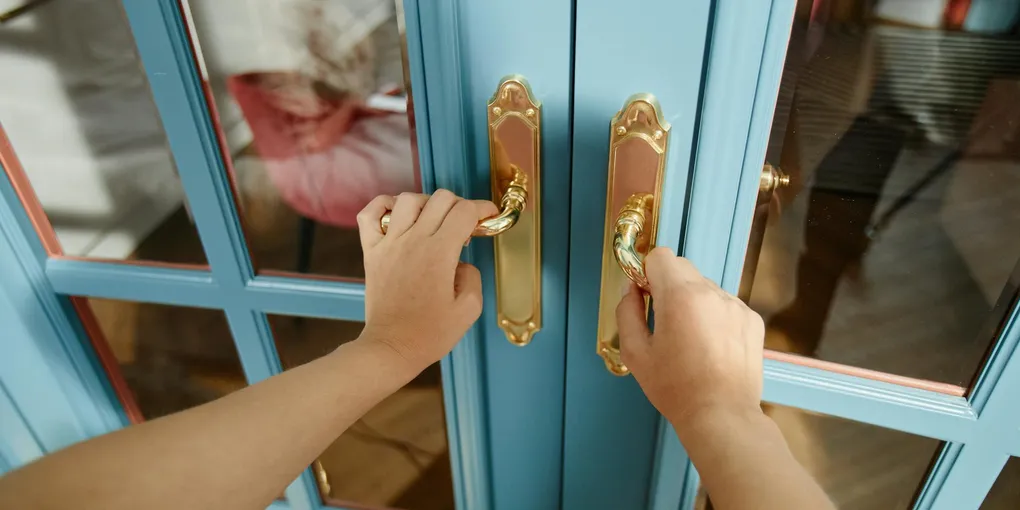
Loose door handle fix: (1) Look for a small hole in the handle shank or collar — this is the set screw hole. Insert an Allen wrench (usually 3/32 or 1/8 inch) and tighten. (2) If no set screw is visible: look for a slot or notch on the back of the collar ring where it meets the door face — insert a flathead screwdriver and pop off the decorative collar. Two screws underneath mount the handle to the door. Tighten them. (3) If the handle is tight but the latch doesn't retract: the spindle (the square rod connecting both handles) is worn — replace the spindle.
Frequently Asked Questions
Where is the set screw on a door handle?
Set screws are usually found in one of two locations: (1) On the neck or shank of the handle, between the lever arm and the collar ring — look for a small hole (1/8 inch) with a hex socket inside. You need a small Allen wrench (hex key) to tighten it — typically 3/32, 1/8, or 5/32 inch. (2) On the underside of the lever arm, near the hub. Some modern handles conceal the set screw behind a plastic plug — pop out the plug with a pin to access the screw. Most hardware stores have Allen wrench sets for $5 that cover all common sizes.
I can't find a set screw anywhere. How is the handle held on?
Handles without visible set screws use a catch-and-release or hidden fastener system: (1) Pop-off collar: the decorative collar ring has a small slot or notch on the side. Insert a thin flathead screwdriver or small pry tool into the notch, twist, and the collar pops off, revealing the mounting screws underneath. (2) Trim plate screws: some handles have two screws visible on the interior escutcheon plate — a decorative plate around the handle on the interior side of the door. Tighten these. (3) Through-bolt system: the two handles are connected by bolts passing through the door. Access is on the interior handle side — unscrew the interior handle to expose the bolt heads. Some older lever handles use a detent pin instead of a set screw — push the pin while pulling the handle off.
I tightened all the screws but the handle is still wobbly. What now?
If screws are tight and the handle still wobbles: (1) The spindle is worn — the square cross bar that runs through the latch mechanism connecting both handles wears over time. A worn spindle has slop in the corners, causing the handle to move without moving the latch. Replace the spindle: purchase a universal door latch spindle at a hardware store ($3–$5). Remove both handles, pull out the old spindle, insert the new one (cut to length if needed), reinstall handles. (2) The handle hub is cracked: the plastic or die-cast metal hub where the handle attaches to the spindle has cracked. Replace the entire handle set. (3) The latch mechanism itself is worn — the handle will feel loose even with a good spindle. Replace the latch cartridge.
My door lever handle droops down instead of sitting horizontal. How do I fix that?
A drooping lever handle has a failed spring return mechanism. The spring inside the handle hub (or latch mechanism) is supposed to return the lever to horizontal after use. When the spring fails: the lever stays wherever gravity puts it — drooping down. Fix: (1) Open the latch case: most levers have a spring cartridge in the latch mechanism that is replaceable. Look up the handle brand and model for the specific spring cartridge part. (2) Some levers have a spring cartridge directly in the handle hub — remove the handle and look for a small internal spring. (3) If the spring cannot be accessed: replace the handle. A lever that droops is annoying but usually not a latch failure — the latch still retracts when you push the lever down.
The handle turns but the door won't open. What is the problem?
Handle turns but latch doesn't retract: the connection between the handle and latch has failed. Most likely: (1) The spindle has slipped out of the latch mechanism — the handle turns freely with no resistance because the spindle is not engaged. Remove the handle and check that the spindle is seated in the latch case. (2) The spindle has broken — if it snapped, the handle turns but nothing moves. Replace the spindle. (3) The latch mechanism has failed internally — the cam or retractor inside the latch case is broken. Replace the latch. For an emergency: if the door is stuck closed, most interior latch cases have a small emergency release slot on the face of the latch bolt. Insert a flathead screwdriver and push the latch bolt in directly to open the door.
How do I fix a loose door handle that has no visible screws?
No-screw handles use one of three hidden fastener systems: (1) Collar pop-off: the most common. Look for a small notch, slot, or hole in the collar ring where it meets the door face. Insert a thin flathead screwdriver into the notch and twist or pry gently — the collar pops free, revealing two screws on the mounting plate underneath. Tighten these screws. (2) Set screw under a cap: a plastic or rubber plug covers the set screw hole. Look for a circular plug on the underside of the lever or on the shank between the lever and door. Pry the plug out with a pin or small flathead. Insert an Allen wrench (hex key) — usually 3/32 or 1/8 inch — and tighten. (3) Detent button: some handles have a small button on the shank that releases the handle from a spline. Press the button while pulling — the handle slides off, exposing the mounting screws behind. After tightening: reinstall everything in reverse. If the screws spin freely and don't grip, the drywall anchor or door hole threads are stripped — use a longer screw or thread lock compound.
How much does it cost to replace a door handle or door knob?
Interior door handle replacement costs $15–$80 for the hardware and 15–30 minutes of DIY labor: budget passage sets (no lock) run $15–$30, privacy sets (bedroom/bathroom lock) $20–$50, and quality Schlage or Kwikset interior sets $40–$80. Exterior door handle replacement costs $30–$150+ for hardware: standard keyed entry lever sets $30–$70, heavy-duty deadbolt + lever combo sets $60–$150, smart locks $100–$300. Hiring a locksmith or handyman to replace a door handle costs $50–$150 in labor for a standard swap — total installed cost including parts is $75–$200 for interior and $100–$350 for exterior. Note: if you are replacing for a broken latch (not just looseness), buy a complete lockset; replacing just the latch cartridge is possible ($10–$20) but requires verifying exact backset dimensions (2-3/8 inch or 2-3/4 inch) and latch bolt diameter.
Fix a loose door handle by tightening the hidden set screw on the handle shank — this solves 80% of wobbly handles in under 5 minutes for $0–$15. Look for a small hole on the side of the handle neck and tighten with an Allen wrench (3/32 or 1/8 inch). If no set screw is visible, the handle has hidden mounting screws behind the collar. Stripped screw holes require wood filler or longer screws to re-grip.
Three-step fix:
- Set screw — Allen wrench (3/32 or 1/8 in.) into the hole on the handle shank; tighten clockwise. Fixes 80% of wobbly handles in 30 seconds.
- Hidden screws — No set screw? Insert a flathead into the collar notch, pop it off, tighten the 2 mounting screws underneath.
- Spindle — Still wobbles? Replace the worn spindle ($3–$5 at any hardware store, 10 min).
What you need
- Allen wrench set (hex keys) — 3/32, 1/8, and 5/32 inch cover most handles
- Flathead screwdriver
- Phillips screwdriver
- Replacement spindle (if spindle is worn)
Step 1: Find and tighten the set screw
Look at the handle shank for a small hole. Insert Allen wrenches until one fits. Tighten clockwise until firm — do not over-tighten (you can strip the set screw).
Test the handle. If it is now solid: done.
Step 2: Access hidden mounting screws
If no set screw found or handle still loose: look for a slot in the collar ring. Insert a thin flathead screwdriver and twist to pop off the decorative collar. Two screws underneath mount to the door. Tighten both firmly.
Step 3: Replace the spindle (if still loose)
If screws are tight but handle still wobbles: remove both handles (pop the collar, unscrew the mounting screws on the interior handle, pull both handles off). The square spindle rod will come out. Take it to the hardware store to match the length and size. Insert the new spindle and reinstall the handles.
Step 4: Test the latch
Turn the handle and confirm the latch retracts fully. If the latch moves but doesn’t retract fully: the spindle may be slightly too long (it limits the rotation of the handle). Trim 1/8 inch from one end with a hacksaw.
Related guides
- How to Replace a Door Knob — full door hardware replacement when repair isn’t enough
- How to Fix a Door That Won’t Latch — latch and strike plate alignment
- How to Fix a Sticking Door — door fitting issues alongside handle repair
- Handyman Cost — if you’d rather hire out the door hardware work, know fair rates
- Find and tighten the set screw
Look for a small hole (about 1/8 inch) on the neck or underside of the handle shank. This is the set screw hole. Insert an Allen wrench — try 3/32, 1/8, or 5/32 inch — and turn clockwise until snug. Test the handle; for 80% of loose handles, this is the complete fix. Takes under 5 minutes, no tools beyond an Allen wrench set.
- Access hidden mounting screws (if no set screw)
If you can't find a set screw, the handle uses hidden mounting screws behind the decorative collar. Look for a small notch or slot on the side of the collar ring. Insert a thin flathead screwdriver into the notch and twist — the collar pops off, revealing two mounting screws. Tighten both screws firmly. Replace the collar by pressing it back until it snaps. Some handles have a small rubber plug covering a set screw — pry it out with a pin to access the hex socket underneath.
- Replace a worn spindle (if still loose)
If screws are tight but the handle still wobbles or turns without retracting the latch, the spindle is worn. The spindle is the square rod running through the door connecting both handles. Remove both handles (unscrew the set screw or mounting screws). Pull the spindle out. Buy a universal door spindle at a hardware store ($3-5). Cut it to the same length as the old one. Insert and reinstall both handles.
- Test the latch and door operation
After tightening, open and close the door several times. The handle should feel solid with no wobble. The latch should retract fully and spring back when released. If the lever droops (doesn't return to horizontal), the spring return has failed — the latch cartridge needs replacement. If the latch doesn't retract at all after spindle replacement, the spindle may not be properly seated in the latch case.
Free: 10-Point Home Maintenance Checklist
Prevent costly repairs with this seasonal checklist. Save hundreds every year by catching problems early.
Your checklist is ready!
Open Checklist →Something went wrong. View the checklist here.