Best Ceiling Fans for Large Rooms: What Size You Actually Need
How to choose the right ceiling fan for large rooms. Covers blade span, CFM ratings, mounting height, and the best fans for rooms over 300 square feet.
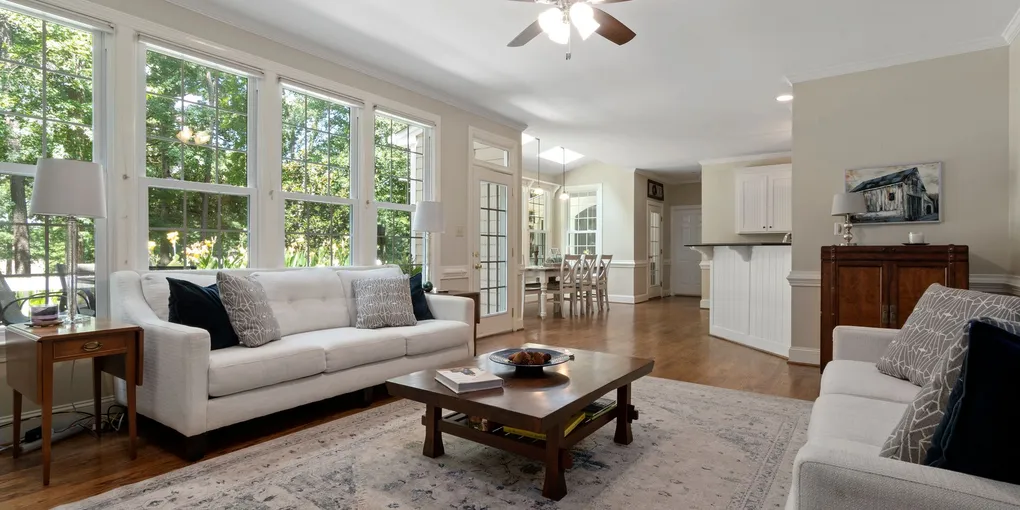
For large rooms over 300 square feet, choose a ceiling fan with at least a 52-inch blade span and 5,000+ CFM airflow. DC motor fans cost more upfront ($150-400) but use 70% less electricity and run quieter. For rooms over 400 square feet, go with a 60-72 inch fan or install two 52-inch fans for more even coverage.
Frequently Asked Questions
What size ceiling fan do I need for a large room?
For rooms 226-400 square feet, choose a 50-54 inch fan. For rooms over 400 square feet, go with 60-72 inches or install two fans. The blade span determines how much air the fan moves.
What is a good CFM rating for a ceiling fan?
For large rooms (300-450 sq ft), look for 5,000-7,000 CFM. For great rooms or vaulted ceilings, aim for 7,000+ CFM. If a manufacturer does not list CFM, skip that fan.
Are DC motor ceiling fans worth the extra cost?
Yes. DC motor fans use 70% less electricity, run quieter, and offer more speed options than AC motor fans. Over 10 years of daily use, a DC fan saves $200-400 in electricity, offsetting the higher upfront cost.
How much does it cost to run a ceiling fan?
A ceiling fan on medium speed costs about $0.01-0.03 per hour, or roughly $5-15 per month running 12 hours daily. Using ceiling fans lets you raise your thermostat by 4 degrees and save 4-8% on cooling costs.
Can I install a ceiling fan myself?
Most homeowners can install a ceiling fan in 1-2 hours if there is existing wiring. The fan must be mounted to a fan-rated electrical box. Hire an electrician if you need new wiring, a box upgrade, or have a vaulted ceiling.
What is the best ceiling fan for a large room in 2026?
The best ceiling fan for large rooms (300–500 sq ft) in 2026 is the Hunter Dempsey 54-inch ($130–$160) — DC motor, 5,675 CFM, quiet operation, and available in multiple finishes. Step up to the Big Ass Fans Haiku ($700–$900) if noise and energy efficiency are paramount — it uses a proprietary DC motor that is nearly silent and uses 80% less energy than comparable AC fans. For great rooms and spaces over 500 sq ft, the Hunter Advocate 60-inch ($220–$280) delivers 7,500+ CFM with a DC motor and remote. Budget pick for large rooms: the Hampton Bay Mara 54-inch ($70–$90) — adequate CFM at 4,900 with an AC motor, fine for occasional use but not as efficient long-term. Key rule: in rooms over 400 sq ft, one 60-inch fan outperforms two 42-inch fans because it moves more air per rotation with less turbulence. For open floor plans over 600 sq ft, use two 52-inch or 60-inch fans placed evenly across the space.
How many ceiling fans do I need for a large open-plan room?
Use one fan per 225–400 sq ft of floor space as a general guide, but placement matters as much as count. A single 60-inch fan in the center of a 500 sq ft room is usually more effective than two 42-inch fans because larger fans create even airflow without turbulence from competing blades. For open floor plans over 600 sq ft with multiple seating zones: two fans, one per zone, outperforms one large central fan because people feel cooling air best when the fan is directly overhead. Ceiling height rule: for ceilings 9 feet and under, flush-mount (hugger) or short downrod. For 10–12 feet, use a 12-inch downrod. For 14+ feet, use a longer downrod (18–36 inches) to bring the fan blades to 8–9 feet above the floor — fans more than 10 feet above the floor lose most of their cooling effect.
The best ceiling fan for large rooms (400–700 sq ft) in 2026 is the Hunter Signal 54-inch ($200–$250) — DC motor, smart home compatible, and Energy Star certified. For rooms over 700 sq ft, go 60 inches or larger. Blade span guide: rooms under 225 sq ft → 42–44 in; 225–400 sq ft → 52 in; 400–700 sq ft → 54–56 in; 700+ sq ft → 60+ in. DC motor fans use 70% less energy than AC motor fans and are quieter.
Most people buy ceiling fans that are too small for their room. A 42-inch fan in a 400-square-foot living room moves about as much air as waving a magazine. The result: the fan runs on high all summer, your energy bill goes up, and you’re still warm.
Getting the right size fan is the single biggest factor in whether it actually cools the room. Here’s how to match fan size to room size, what CFM means, and which fans are worth buying for large spaces.
How to Size a Ceiling Fan
The blade span (diameter) determines how much air the fan moves. Here’s the sizing guide:
| Room Size (sq ft) | Blade Span |
|---|---|
| Up to 75 | 29-36 inches |
| 76-144 | 36-42 inches |
| 145-225 | 44-50 inches |
| 226-400 | 50-54 inches |
| Over 400 | 60-72 inches, or two fans |
For large rooms (300+ sq ft), you need at least a 52-inch fan. For great rooms, open floor plans, or rooms over 400 square feet, go with 60 inches or larger.
CFM: The Number That Actually Matters
CFM stands for cubic feet per minute — the volume of air the fan moves. A higher CFM means more airflow and better cooling.
What to look for:
- Under 3,000 CFM: Small rooms only. Not enough for large spaces.
- 3,000-5,000 CFM: Good for medium rooms (150-300 sq ft).
- 5,000-7,000 CFM: Ideal for large rooms (300-450 sq ft).
- 7,000+ CFM: Great rooms, vaulted ceilings, or very large spaces.
CFM is listed on the box or product page of any decent fan. If a manufacturer doesn’t list it, skip that fan.
CFM Per Watt: Efficiency Matters
CFM per watt tells you how efficiently the fan moves air. Higher is better.
- Under 50 CFM/W: Inefficient. Old AC motor design.
- 50-100 CFM/W: Average. Acceptable for most uses.
- 100-200 CFM/W: Good. Most DC motor fans land here.
- 200+ CFM/W: Excellent. Best-in-class efficiency.
DC motor fans cost more upfront ($150-400 vs $50-150 for AC motors) but use 70% less electricity and run quieter. Over 10 years of daily use, a DC fan saves $200-400 in electricity compared to an equivalent AC motor fan.
Mounting Height
The bottom of the fan blades should be at least 7 feet above the floor for safety, and ideally 8-9 feet for best airflow.
- Standard ceiling (8 ft): Use a flush mount or hugger fan with no downrod.
- 9-foot ceiling: Use a 3-4 inch downrod.
- 10-foot ceiling: Use a 6-12 inch downrod.
- Vaulted ceiling: Use an angled mount adapter plus an appropriate downrod.
If your ceiling is higher than 10 feet, the fan needs to hang lower on a longer downrod, or the air won’t reach the living space effectively.
What to Look for in a Large-Room Fan
Must-haves:
- Blade span 52 inches or larger
- CFM of 5,000+
- Reversible motor (clockwise for winter, counterclockwise for summer)
- At least 3 speeds
Nice-to-haves:
- DC motor (quieter, more efficient, more speed options)
- Remote control or smart home integration
- Dimmable integrated LED light
- Damp rating if near covered outdoor areas
Skip:
- Fans that don’t list CFM
- Blade spans under 50 inches for rooms over 300 sq ft
- Fans with only pull-chain controls (inconvenient in large rooms with high ceilings)
Budget Breakdown
| Category | Price Range | What You Get |
|---|---|---|
| Budget | $80-150 | AC motor, 52”, basic remote, 3 speeds |
| Mid-range | $150-300 | DC motor, 52-60”, full remote, 6+ speeds, LED |
| Premium | $300-600 | DC motor, 60-72”, smart controls, whisper-quiet, high CFM |
For most large rooms, the mid-range ($150-300) is the sweet spot. You get the efficiency and quiet of a DC motor without paying for premium aesthetics.
Installation Tips
DIY difficulty: Moderate. If you’re comfortable on a ladder and can turn off a breaker, most people can install a ceiling fan in 1-2 hours.
When to hire an electrician:
- No existing ceiling box (need to run new wiring): $150-300
- Need to upgrade from a light-only box to a fan-rated box: $75-150
- Vaulted ceiling installation: worth paying for safety
Critical safety note: Ceiling fans are heavy (15-50 lbs). They MUST be mounted to a fan-rated electrical box, not a standard light fixture box. Standard boxes are rated for 15-25 lbs and will eventually pull loose from the joist, dropping the fan. Check by turning off power, removing the existing fixture, and looking for a label on the box that says “fan-rated” or “suitable for fan support.”
Fan-rated boxes cost $10-15 at any hardware store. If you need to install one, the expandable brace type works for most situations without attic access.
Two Fans vs One Large Fan
For rooms over 500 square feet or L-shaped rooms, two 52-inch fans usually outperform a single 72-inch fan. Benefits:
- More even air distribution
- Each fan can be controlled independently
- Easier to install (lighter, more standard mounting)
- Often cheaper total than a single premium large fan
Space them evenly so their coverage overlaps slightly in the center.
Running Costs
A ceiling fan on medium speed costs about $0.01-0.03 per hour to run, or roughly $5-15 per month if left on 12 hours per day. Compare that to running your AC, which costs $0.15-0.50 per hour.
Using ceiling fans lets you raise your thermostat by 4°F without losing comfort. For most homes, that translates to 4-8% savings on cooling costs — easily $50-150 per summer.
The fan pays for itself in energy savings within 1-3 cooling seasons, depending on how much you rely on AC. Ceiling fans are one of the most cost-effective eco-friendly home improvements you can make.
No existing ceiling box? See how to install a ceiling fan with no existing wiring for the retrofit steps. And for complete fan-installation pricing with or without existing wiring, check our ceiling fan installation cost guide.
Ready to install? See our full how to install a ceiling fan step-by-step guide. For a finished look in large rooms, pair the fan with crown molding — it frames the ceiling and makes the fan the focal point rather than an afterthought.
Free: 10-Point Home Maintenance Checklist
Prevent costly repairs with this seasonal checklist. Save hundreds every year by catching problems early.
Your checklist is ready!
Open Checklist →Something went wrong. View the checklist here.