How to Fix a Garage Floor Oil Stain: From Fresh Spill to Old Set Stains
Oil and grease stains don't have to be permanent. Learn how to absorb fresh spills with cat litter, attack set stains with degreasers and poultice, and seal the concrete to prevent future staining.
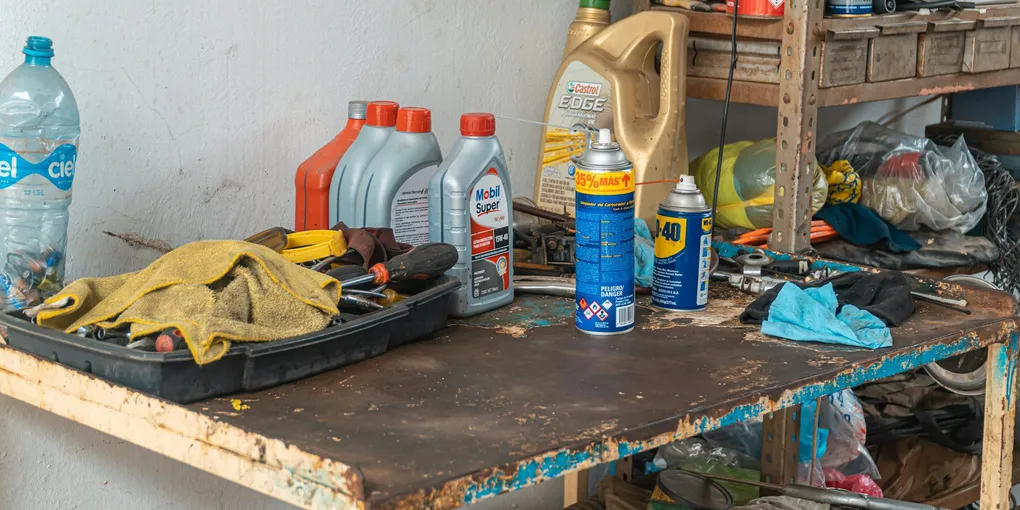
Removing garage floor oil stains by age: (1) Fresh spill (under 1 hour) — cover immediately with cat litter or oil-dry absorbent, grind in with your foot, leave 30+ minutes, sweep up; repeat as needed. (2) Recent stain (days to weeks) — pour concentrated concrete degreaser on the stain, scrub with a stiff brush, rinse; may need 2-3 applications. (3) Old set stain (months to years) — make a poultice: mix degreaser or paint thinner into diatomaceous earth or cat litter to a peanut-butter paste, trowel over the stain 1/4 inch thick, cover with plastic for 24-48 hours, then scrub and rinse. After the stain is removed, seal the concrete to prevent future penetration.
Frequently Asked Questions
Does cat litter actually remove oil stains from concrete?
Cat litter (plain clay type, not clumping) is highly effective on fresh oil spills — it absorbs oil before it penetrates the concrete pores. For stains that have already set, it is less useful on its own. The right approach for set stains is a concrete degreaser or poultice, which actively breaks down the oil bond rather than just absorbing surface oil.
Will a pressure washer remove oil stains from a garage floor?
A pressure washer alone will not remove set oil stains because water and oil don't mix. You need a degreaser applied first. Saturate the stain with concrete degreaser, let it dwell 15-30 minutes, then pressure wash or scrub. The combination of chemistry and mechanical action removes the oil. A pressure washer used alone just spreads the stain and wastes water.
How do I prevent garage floor oil stains?
The most effective prevention is sealing the concrete floor with a penetrating silane/siloxane sealer or an epoxy coating. Sealed concrete resists oil penetration — spills bead up and can be wiped up instead of soaking in. Garage floor mats or drip trays under vehicles are the low-cost alternative. Change to drip-tray use between the vehicle inspection that found the leak and the repair appointment.
How much does garage floor oil stain removal cost?
DIY: $10-$30 for cat litter, degreaser, and a stiff brush — most households already have these. Professional concrete cleaning and degreasing: $100-$300 for a standard 2-car garage. Epoxy floor coating (which covers remaining stains and prevents future ones): $300-$600 DIY kit, $1,200-$3,000 professionally installed.
Removing garage floor oil stains by age: (1) Fresh spill (under 1 hour) — cover immediately with cat litter or oil-dry absorbent, grind in with your foot, leave 30+ minutes, sweep up; repeat as needed. (2) Recent stain (days to weeks) — pour concentrated concrete degreaser on the stain, scrub with a stiff brush, rinse; may need 2-3 applications.
Every garage floor tells the same story in oil. Drips from a parked car, a tipped-over oil drain pan, a leaky lawn mower — it all ends up on the concrete, and concrete is basically a sponge for petroleum products. Oil penetrates the pores of concrete quickly and bonds with the mineral matrix, which is why those dark stains seem impossible to remove.
The key variables are time and depth. A fresh spill that’s been sitting for an hour is far easier to remove than a stain that’s been soaking in for years. This guide covers the full spectrum — from absorbing a fresh spill immediately, to attacking deep-set stains with a poultice, to sealing the floor so future spills wipe up before they ever become stains.
What You Need
Have these materials on hand before you start. For older stains you may need to go through several cycles of cleaning, so buying enough product the first time saves extra trips to the hardware store.
- Oil dry / clay-based cat litter (plain, non-clumping) — the original and still-effective first response for fresh spills
- Concrete degreaser / alkaline cleaner — breaks down petroleum bonds in the concrete pores
- Trisodium phosphate (TSP) cleaner — heavy-duty surfactant for stubborn set stains
- Stiff-bristle scrub brush or drill-mounted scrub brush — mechanical agitation is essential for breaking up oil bonds
- Poultice powder or diatomaceous earth — for deep-set stains, draws oil out of concrete as it dries
- Penetrating concrete sealer — seals pores to prevent future staining and make cleanup easy
Understanding Why Oil Stains Are Difficult
Concrete looks solid, but it’s actually a porous material full of microscopic channels and voids. When motor oil or grease contacts concrete, capillary action draws it into those pores — the same way a sponge draws up water. Once inside, the oil bonds with the calcium silicate hydrate that gives concrete its strength.
Simple soap and water can’t break those bonds. You need either:
- Surfactants that emulsify the oil (break it into tiny droplets that can be rinsed away), or
- A poultice that physically wicks the oil back out of the concrete as it dries, or
- A combination of both for older, deeper stains
The longer oil has been in concrete, the deeper it has penetrated and the more it has oxidized and bonded. This is why speed matters for fresh spills and why old stains require more aggressive methods.
Treating a Fresh Oil Spill (Less Than 24 Hours Old)
Act fast. Every hour that passes, the oil penetrates deeper.
Step 1: Absorb the surface oil. Dump a generous amount of clay-based cat litter (the cheap, non-clumping kind) or commercial oil dry directly on the spill. Use enough to cover the entire spill with at least a half-inch layer.
Step 2: Work it in. Use your foot or a stiff brush to grind the absorbent into the spill. This isn’t just surface absorption — you’re working the material into contact with the oil and breaking up the surface tension.
Step 3: Let it sit. Leave the absorbent in place for at least 30 minutes, preferably a few hours. The longer it sits, the more oil it wicks up.
Step 4: Sweep and dispose. Sweep up the absorbent and dispose of it in a sealed bag. Check your local regulations — oil-saturated absorbent material is considered hazardous waste in many areas and shouldn’t go in regular trash.
Step 5: Apply degreaser. Even with quick absorption, some oil has already penetrated. Apply a concrete degreaser to the area according to label directions. Most degreasers are diluted with water and applied to a wet surface. Let it dwell for 5–10 minutes.
Step 6: Scrub. Use a stiff-bristle brush to scrub the degreaser vigorously into the stain. A drill-mounted scrub brush saves a lot of effort. The combination of chemistry and mechanical action is what lifts the oil out.
Step 7: Rinse. Rinse thoroughly with water. Collect the rinse water — it contains oil and shouldn’t go down a storm drain. A wet/dry shop vac works well for collecting rinse water.
Step 8: Evaluate and repeat. The stain should be significantly lighter. If it’s still dark, let the area dry completely and repeat the degreaser/scrub/rinse cycle.
Treating a Set Oil Stain (Days to Months Old)
Once oil has had time to penetrate and bond, you need a more aggressive approach.
Start with degreaser. Even for old stains, start with a commercial concrete degreaser. Apply it hot (undiluted or at the high end of the concentration range), let it dwell 15–20 minutes, scrub hard, and rinse. This removes surface contamination and prepares the concrete for deeper treatment.
Apply TSP solution. Trisodium phosphate is a heavy-duty cleaner that’s effective on oil and grease. Mix according to package directions (typically 1/2 cup TSP per gallon of hot water). Apply to the stain, scrub thoroughly, and rinse completely. Wear rubber gloves — TSP is caustic. Dispose of rinse water properly.
Evaluate the result. Some stains respond to aggressive degreasing alone. If the stain is significantly lighter after the TSP treatment, you may be done. If it’s still visibly dark, move on to the poultice method.
The Poultice Method for Deep-Set Stains
A poultice works by drawing oil out of the concrete rather than dissolving it. As the poultice material dries, it pulls the oil with it — like a reverse sponge. This is the most effective method for stains that have been set for months or years.
Make the poultice. You need an absorbent powder mixed with a solvent or degreaser to a peanut-butter consistency. Options for the powder include:
- Diatomaceous earth (most common and effective)
- Portland cement
- Talcum powder
- Commercial poultice powder
Options for the liquid to mix in include:
- Acetone or lacquer thinner (for petroleum stains)
- Commercial liquid degreaser
- Mineral spirits
Mix to a thick paste. The paste should be firm enough to hold its shape but not dry or crumbly.
Apply the poultice. Spread it over the entire stain about 1/4 to 1/2 inch thick, extending slightly beyond the stain edges. Work it into the surface firmly.
Cover with plastic. Cover the poultice with plastic sheeting and tape the edges down to slow the drying process. Slow drying means more time for the poultice to wick oil out of the concrete. Leave it in place for 24–48 hours.
Remove and evaluate. Peel up the plastic and let the poultice dry completely (if it’s not already). Scrape up the dried material and sweep clean. The poultice should have absorbed oil and be darker in color than when you applied it — that’s the oil it pulled out.
Rinse and assess. Rinse the area and evaluate the stain. A single poultice application typically lightens a deep stain by 50–80%. Very old stains may require two or three applications to reach acceptable results.
Follow with degreaser. After the poultice treatment, apply degreaser and scrub to remove any surface residue. Rinse thoroughly.
Dealing with Transmission Fluid and Grease Stains
Transmission fluid is more fluid than motor oil and tends to spread farther. Treat it the same as motor oil but be prepared to cover a larger area. Grease (chassis grease, bearing grease) is heavier and doesn’t penetrate as quickly as oil, but it’s resistant to water-based cleaners. Start with a solvent-based degreaser rather than a water-based one, then follow with the poultice method if staining remains.
Managing Expectations on Old Stains
Old oil stains that have been soaking for years may never completely disappear. With aggressive treatment you can typically lighten them by 80–95%, but the last bit of deep contamination may be permanent. At that point your options are:
- Concrete floor paint or epoxy coating: Covers the stains completely and creates a durable, easy-to-clean surface.
- Garage floor mats or tiles: Modular interlocking tiles or a rubber mat cover the problem and protect against future stains.
- Accept the result: Lightened stains on a working garage floor are entirely normal and don’t affect the concrete structurally.
Step 6: Seal the Concrete to Prevent Future Stains
After cleaning, once the concrete is completely dry (allow 72 hours minimum), apply a penetrating concrete sealer. This is the single best thing you can do to prevent future staining problems.
Penetrating sealers — silane or siloxane-based — soak into the concrete and react chemically with the minerals to fill the pores from the inside. They don’t leave a surface film. Oil spills on sealed concrete bead up instead of soaking in, giving you time to clean them up before they penetrate.
Apply the sealer according to manufacturer directions, typically with a pump sprayer or roller. Most penetrating sealers need two coats. Let the first coat absorb fully before applying the second. The sealer will be invisible when dry — the concrete will look the same, but it will be dramatically more resistant to staining.
Reapply sealer every 3–5 years for ongoing protection.
FAQ
-
question: “Will WD-40 remove an oil stain from concrete?” answer: “No — WD-40 is itself an oil-based product. Applying it to a concrete oil stain would make the problem worse by adding more petroleum to the concrete. Use a purpose-formulated concrete degreaser instead.”
-
question: “Is it safe to pour bleach on a garage floor oil stain?” answer: “Bleach doesn’t break down petroleum-based stains — it oxidizes organic material but doesn’t emulsify oil. It will lighten some surface discoloration but won’t remove the oil from the concrete. It can also react with some cleaning products to produce harmful gases. Stick to concrete degreasers and TSP.”
-
question: “How long do I have before an oil spill becomes a permanent stain?” answer: “There’s no hard cutoff, but the first 30 minutes are when the most absorption happens. Within a few hours, significant penetration has occurred. After 24 hours, the stain is well set and will require more aggressive treatment. That said, even year-old stains can often be substantially lightened with the right approach.”
-
question: “Can I pressure wash an oil stain off garage concrete?” answer: “Pressure washing alone doesn’t remove oil — water and pressure can’t break petroleum bonds. Pressure washing in combination with a degreaser is more effective. Apply degreaser, let it dwell, then use the pressure washer to rinse. Be careful about where the oily rinse water goes — don’t let it run into storm drains.”
-
question: “My garage floor has years of accumulated oil. Should I just apply epoxy coating over it?” answer: “You can, but only after thorough degreasing. Epoxy and other garage floor coatings won’t bond to oil-contaminated concrete — they’ll peel within months. Clean as thoroughly as possible, then apply a bonding primer before the epoxy top coat. The degreasing step cannot be skipped.”
-
question: “Is oil-dry (clay absorbent) better than cat litter for fresh spills?” answer: “Commercial oil-dry is slightly better — it’s engineered specifically for petroleum absorption and has a higher absorption capacity. Cheap clay cat litter is a very close second and is available everywhere. Either works well for fresh spills. Avoid clumping or crystal cat litters, which don’t absorb well and can create a mess.”
Related Reading
- How to Organize a Garage for Maximum Storage
- How to Paint a Garage Floor with Epoxy Coating
- How to Fix a Cracked Concrete Driveway
- Understanding Why Oil Stains Are Difficult
Concrete looks solid, but it's actually a porous material full of microscopic channels and voids. When motor oil or grease contacts concrete, capillary action draws it into those pores — the same way a sponge draws up water.
- Treating a Fresh Oil Spill (Less Than 24 Hours Old)
Act fast. Every hour that passes, the oil penetrates deeper.
- Treating a Set Oil Stain (Days to Months Old)
Once oil has had time to penetrate and bond, you need a more aggressive approach.
- The Poultice Method for Deep-Set Stains
A poultice works by drawing oil out of the concrete rather than dissolving it. As the poultice material dries, it pulls the oil with it — like a reverse sponge. This is the most effective method for stains that have been set for months or years.
- Dealing with Transmission Fluid and Grease Stains
Transmission fluid is more fluid than motor oil and tends to spread farther. Treat it the same as motor oil but be prepared to cover a larger area.
- Managing Expectations on Old Stains
Old oil stains that have been soaking for years may never completely disappear. With aggressive treatment you can typically lighten them by 80–95%, but the last bit of deep contamination may be permanent. At that point your options are:
Free: 10-Point Home Maintenance Checklist
Prevent costly repairs with this seasonal checklist. Save hundreds every year by catching problems early.
Your checklist is ready!
Open Checklist →Something went wrong. View the checklist here.